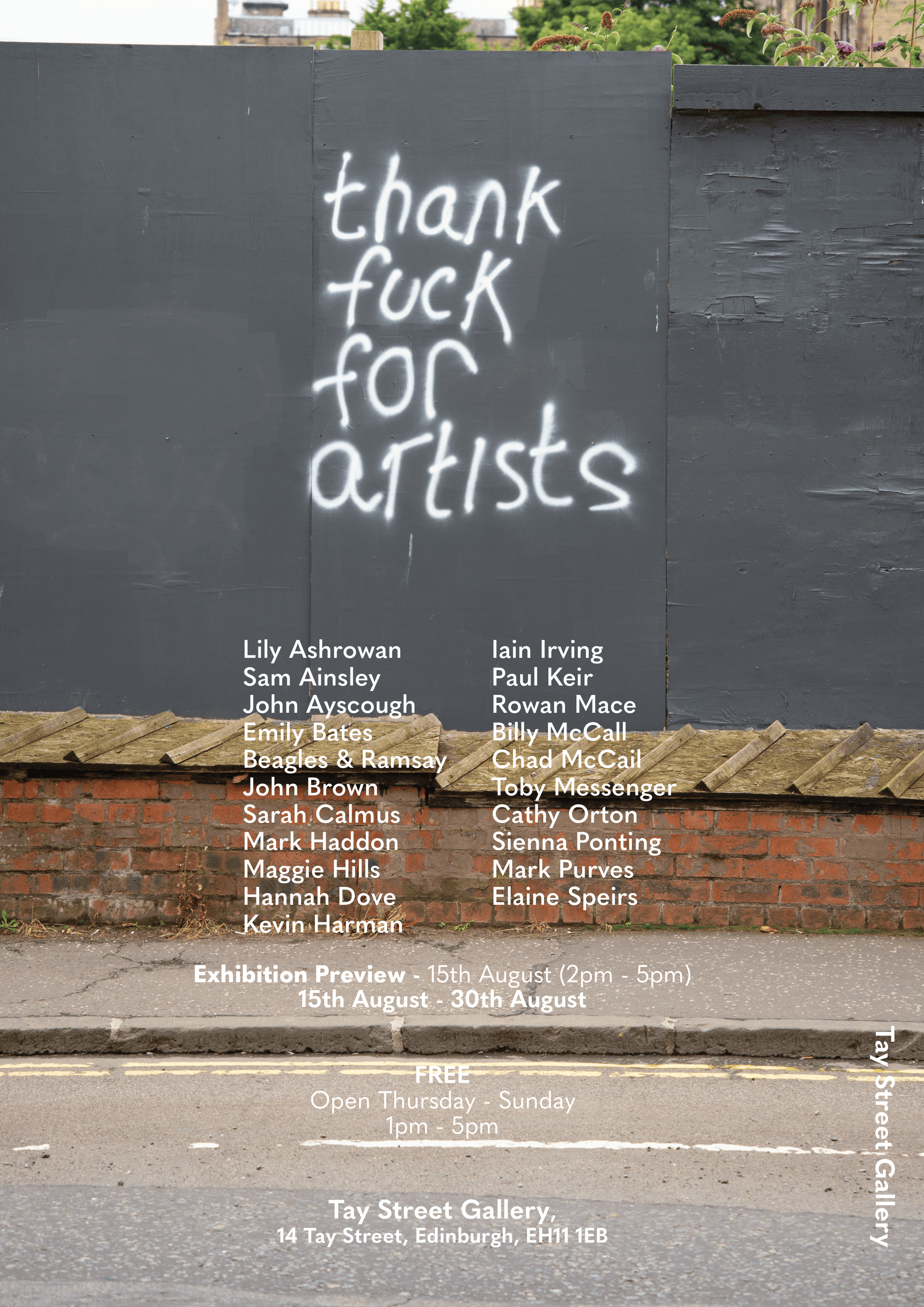
"Thank fuck for artists" is a celebration, a toast, a flicker of
relief that people keep imagining, keep trying, keep making, not for
applause or profit, but because that's how we enlarge the world we
share. It’s also a heartfelt thank you to those who keep making. It's
for the people who shape our visual and cultural landscape in ways
that we often overlook, who give form to feelings and make space for
us to reflect and imagine. It's for those who keep working, not
because they know the outcome, but because the act itself is how they
engage and grapple with the world. In that sense, it's less about
who's watching and more about keeping a conversation alive that
belongs to all of us.
Here, in a half renovated tenement in Edinburgh, art isn't waiting for
perfect conditions. Instead, it finds its way into spare rooms and
borrowed spaces of a half-finished building. Creativity doesn't arrive
once everything's sorted. It's there while the dust is still in the
air.
This exhibition brings together 21 artists from recent graduates to
mid and late-career artists who have kept their practise alive for
decades. What connects us is less about money or recognition and more
about that shared persistence and the choice to keep making and keep
exploring. Artists don't work in isolation from the world. Our ideas
spill out everywhere, into design, architecture, fashion, the small
details of everyday life. But that influence is easy to miss. You walk
in, spend time, and leave again, owing nothing at the door. That's not
a flaw, it's a kind of openness. This show isn't asking for sympathy
or putting artists on a pedestal, it's simply saying that our shared
culture relies on people who imagine alternatives and share them
generously. Shared culture isn't an idea, it's the texture of daily
life, the poster on the street, the type on a ticket, the colours of a
cafe interior. All of these small choices are seeded by artists'
experiments, years of trying, failing, and trying again. Much of this
happens quietly, without a price tag, yet it permeates how we see,
gather, and relate to one another. That's the generosity at art's
core. A common ground we all stand on, whether we notice it or not.
Over the past 20 years, funding cuts and rising costs have made life
for many artists precarious; studio rent increases, materials costs
and simply putting food on the have become increasingly difficult and
for some, impossible to negotiate. Many European countries tend to
invest more steadily, treating cultural infrastructure as long-term
public good. However, it's not really about who gets it right, it's
about what we want a society to be. If we want vibrant cities and
thoughtful public spaces, a culture that feels rich and alive, then we
must look after the people who make that possible. A society that
invests in artists is really investing in imagination, in identity,
and in its own future.
Participating Artists
Lily Ashrowan
Sam Ainsley
Emily Bates
Beagles & Ramsay
John Brown
Sarah Calmus
Mark Haddon
Hannah Dove
Kevin Harman
Paul Keir
Cathy Orton
Sienna Ponting
Mark Purves
Elaine Speirs
Rowan Mace
Billy McCall
Chad McCail
Toby Messenger
Maggie Hills
Iain Irving
#THANKFUCKFORARTISTS
Tay Street Gallery
Mark Haddon
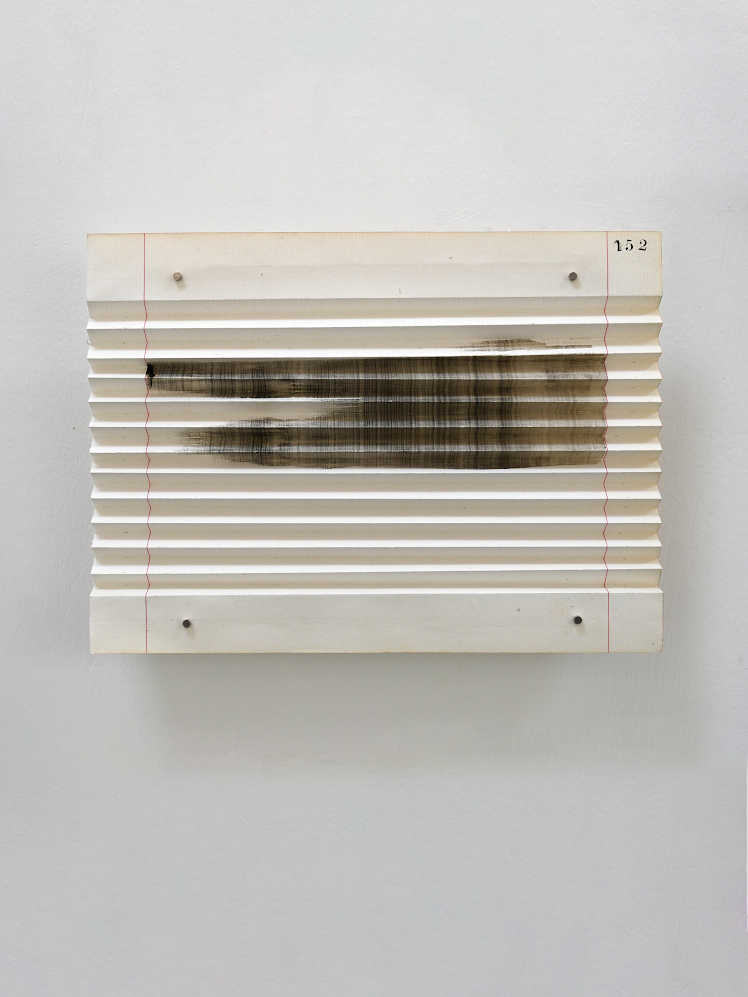
I first met Mark Haddon in 1988 at Edinburgh College of Art. He was a year above me and even then, he was one of those students people talked about. My friends and I admired his work, not because it was flashy, but because it felt quietly sure of itself. Almost 40 years later, listening to Mark talk about his work, I'm struck by how consistent he's been. We live in a culture that demands neat artist statements and clear intentions, but Mark doesn't work that way. He notices things. Crumpled paper, bits of wood, discarded ribbon not as metaphors but as themselves. He said something that has stayed with me. The thing is always the thing. It sounds simple but it feels like the core of his practice. What moved me most in our conversations was when Mark talked about sharing a world with other human beings. That sense that the marks on a page, or the wear on a piece of wood are traces of lives already lived. His work feels generous in that way. Like an acknowledgement of others, rather than a claiming. He once used the phrase "mucking about" It made me smile. It sounds almost dismissive but I think it's profound. Great artists often look like they're playing. They experiment, they follow accidents, they allow things to unfold. What looks like mucking about is often deep attention built over years. Writing this, I realise I'm not trying to explain Mark's work as much as describe the consistency of the person behind it. The Mark I admired as a student, and the artist I listen to now, are recognisably the same. In a world that rewards reinvention, there's something deeply inspiring about someone who has spent decades simply becoming more fully themselves. There's a patience in Mark’s work, a sense that Making is thinking, that work doesn't illustrate an idea, it discovers itself in the doing. That attitude feels at a piece with No31, the gallery he runs, not as a career move, but as a space for attention, for slowing down enough to notice. This essay doesn't try to explain his work better than he does. It tries instead to honour a way of being with the world, insistent, unshowy, and necessary.
Mark Haddon is a Scottish contemporary artist, designer, curator and illustrator based in the Scottish Borders. Working across drawing, painting, sculpture, installation and found objects, his practice explores memory, place, observation and the relationships between natural and human-made environments. He is also the founder and curator of No31, an artist-run gallery and project space in Duns, Scottish Borders (markhaddon.net.)